Precision Roll Corrugation Helps Ensure Grain Processing Quality
In commercial grain processing, the consistency and quality of your final product both rely heavily on how well the raw grain is processed. Whether you’re processing grain for feed, flour, or oilseed meal, precision-functioning roller equipment ensures that you get the end product quality and consistency you’re looking for.
Naturally, one of the most important aspects that decides grain processing quality is roll corrugation. Regardless of what type of roller system you employ, it’s the roll corrugation itself that ultimately shapes the final product on a molecular level.
How Roll Corrugation Affects Grain Consistency
One of the most critical factors in determining product consistency is how kernels are crushed or ground. Particle size, kernel breakage, temperature rise, and moisture retention are all directly affected by the rollers and their corrugations.
At Scherer, three decades of working with customers throughout the industry have shown us that precision roll corrugation is crucial to achieving high yield, consistent quality, and ongoing efficiency in processing.
Here’s a deeper dive into why properly designed and maintained rolls absolutely matter, and how custom corrugations tailored to your specific grain and processing needs can make a big impact on your bottom line:
Better Roller Corrugation = Better Grain Feed Quality
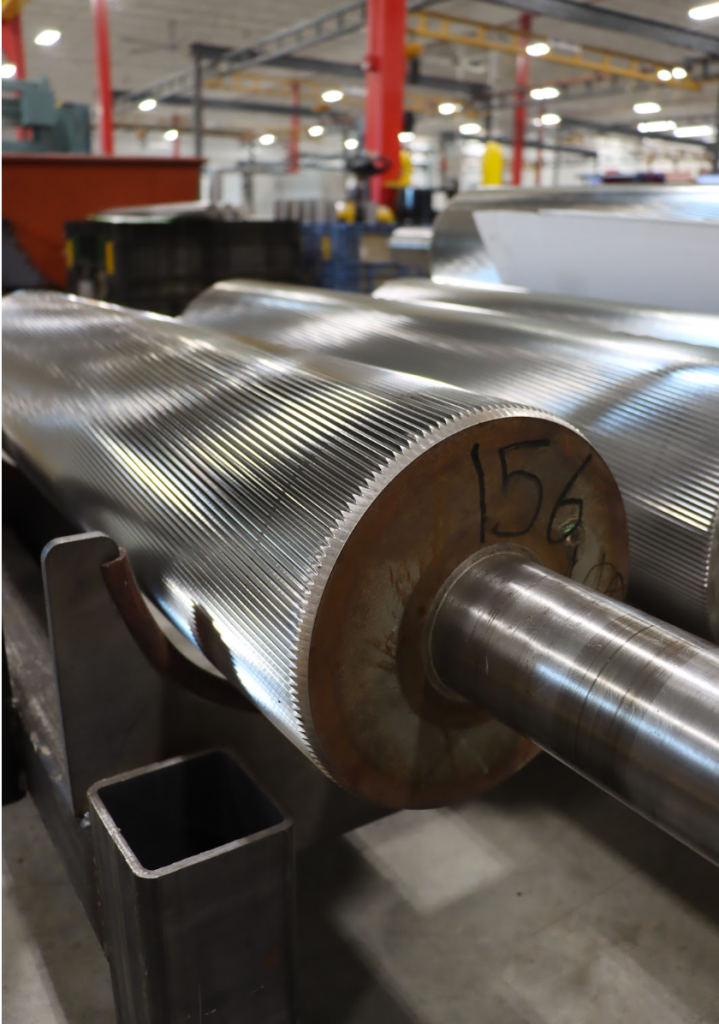
- Crushing and Grinding Action – Corrugations (the grooves or teeth machined into roll surfaces) determine how kernels are gripped, crushed, and sheared. The depth, shape, spacing, and angle of corrugations influence how aggressively or gently the kernel is broken.
- Particle Size Distribution – Uniformity of corrugation helps ensure that similar-sized particles are produced, reducing fines (very small particles) and unbroken kernels. Lower fines mean less wasted feed, more predictable digestion (for feed), and reduced losses.
- Wear and Heat Distribution – Corrugations affect how rollers contact the grain. Poorly designed corrugations (or worn, mismatched rollers) can create uneven pressure, slipping, or excessive friction, leading to excessive heat, more wear, and potentially damaged grain (e.g., roasting or staling it).
- Throughput and Efficiency – Efficient corrugations with optimized shape, which are sharp and in good condition, reduce the force required per ton processed, which lowers power consumption and allows higher throughput.
Custom Roll Corrugations: Tailoring Your Tools to Your Product Needs
No two grains or two milling operations are exactly alike. Corn, soybeans, wheat, barley, oilseeds… they each have unique hardness, moisture, kernel structure, as well as a multitude of different end‐use requirements. Even for the same grain, different customers may desire different particle sizes or processing intensities (e.g. crushed seed vs. ground meal). That’s why custom mill roll corrugations are a core capability here at Scherer.
| Customization Factor | What We Consider | How Variation Impacts Product Quality |
| Corrugation Pattern or Profile
(e.g. saw‐tooth, round, V, twin‐cut) |
The shape of ridges/grooves and the sharpness. Different patterns grip and shear differently. | A twin-cut or saw tooth pattern may allow fast cracking with minimal fines. A rounder groove may produce a gentler crush, beneficial for delicate materials or reducing dust. |
| Corrugation Depth and Pitch
(i.e. spacing between ridges) |
Deeper corrugations allow larger kernel engagement. Tighter pitch produces more shearing per unit length. | Deep and wide spacing for coarser cracking (coarse feed). Shallower and closer spacing for fine grinding or flour. (Too deep or too coarse leads to unbroken kernels; too fine or close may generate heat or fines.) |
| Roll Material and Hardness | With different grades of chilled iron, we can match the roll material to your application. | Material choice affects durability of corrugation. Hardness influences how long corrugation stays sharp and consistent. Some coatings help resist corrosion or abrasion. |
| Roll Diameter, Length and Speed | Larger diameter rolls provide different bite vs. smaller. Length affects how many corrugations are in contact. Speed influences shear rate. | Speed and diameter affect power draw and heat. Matching roll specs to corrugation pattern ensures that processing rate is consistent without overloading motors or causing damage. |
| Gap Adjustment and Roll Alignment | Ability to adjust gap precisely and maintain alignment across roll width. | Proper gap setting ensures uniform crushing across the whole face. Misalignment or gap variation causes hot spots, uneven particle size, more fines, and possibly uncrushed kernels. |
Optimizing Mill Roll Corrugation for Customers Since 1994
When you choose precision roller corrugation, you set the foundation for high‐quality grain processing. That means fewer unbroken kernels, more consistent particle size, less energy waste, and better end-product yield. For decades, Scherer has partnered with leading grain processors not just to supply rolls, but to optimize the entire system.
From roll material, corrugation profile, alignment, and gap control, to ongoing maintenance and resharpening, Scherer has your equipment covered.
Contact us to learn how we can increase grain quality in your operation.